
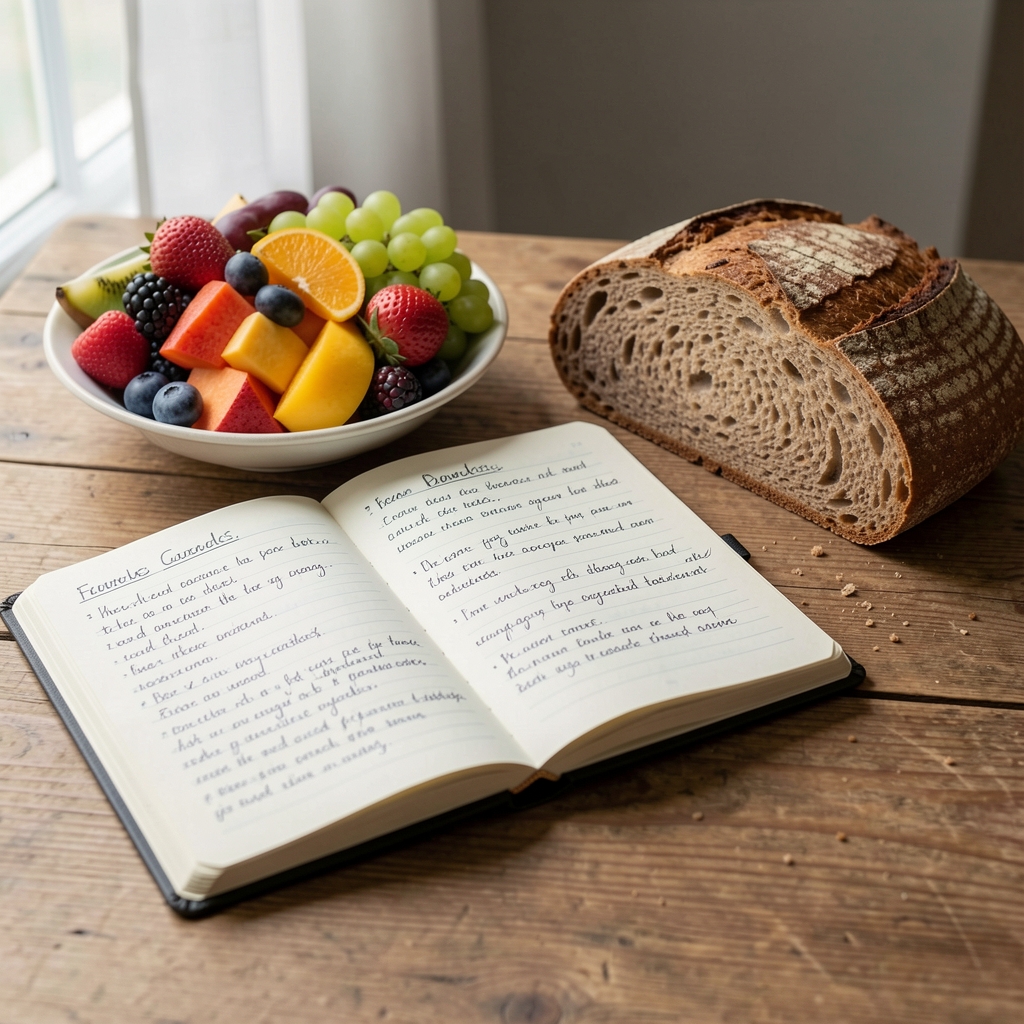
The notebook on my kitchen shelf contains three years of daily food records. It is not a diet diary in the commercial sense — there are no calorie tallies, no red marks for excess, no prescriptive targets written at the top of each page. It is, more accurately, a logbook: a record of what was eaten, when, and in what approximate quantity. Its value is almost entirely retrospective.
The Resistance to Writing It Down
The objection that keeps most people from food journalling is not laziness — it is something closer to an instinct against scrutiny. Writing down what one eats introduces an observer into the experience of eating, and that observer's presence changes the experience in ways that feel threatening before they feel useful. There is a fear that the record will be a record of failure, and that seeing the failures in sequence will be demoralising rather than instructive.
This fear is understandable but, in my experience and in the experience of the readers who have corresponded with this publication, largely unfounded. The record turns out not to be a catalogue of failures. It is, typically, a catalogue of patterns — and patterns are a different thing from failures. A pattern is not a judgement; it is a description of what is recurring. The value of seeing what is recurring is that it becomes possible to ask why, which is a productive question, and to consider whether that pattern is one that serves the life one is trying to live.
The other objection — that food journalling creates an unhealthy relationship with eating by making food a subject of constant attention — is worth examining more carefully. There is a version of food journalling that does this: the kind that involves precise weighing, elaborate calorie calculation, and the classification of foods as permitted or forbidden. This kind of record does tend to produce anxiety and distorted eating. But it is not the only kind. A record kept in plain language — "lentil soup, two bowls, midday; apple; rye toast with oil and tomatoes; pasta with vegetables in the evening" — requires neither calculation nor classification. It is simply a description of the day's food, written without judgment, useful for reading later.
What the Weekly Review Reveals
The most useful practice I have developed in three years of food journalling is the weekly review. On Sunday evenings, I read back through the seven days just completed and note what patterns emerge. Not to evaluate or correct, but simply to observe. What appears most often? What is absent that I expected to find? On what days did the record feel scattered — eating at irregular times, picking rather than sitting down to a meal — and what was happening in the rest of life on those days?
The weekly review produces a kind of nutritional awareness that is qualitatively different from the awareness one has in the moment of eating. Moment-to-moment food awareness is shaped by hunger, mood, convenience, and habit — and these forces are powerful enough to make any single meal feel like a reasonable choice in its context. The weekly review operates at a different scale. It sees the week as a whole and notices what the individual moment could not: that vegetables appeared only three times in seven days, or that protein-rich whole foods were reliably present at lunch but absent from most dinners, or that cooking from scratch happened every day until Wednesday and then stopped.
These observations are not failures. They are data. And data, approached without judgment, tends to produce curiosity rather than shame. The question "I wonder why vegetable variety dropped after Tuesday" is a productive question that invites planning and reflection. It is very different from "I ate badly this week" — a verdict that typically produces no useful response other than a brief intention to do better, which dissolves by Monday.
"The food journal is not a moral document. It is a record of what happened. The most useful question it enables is not 'was this good?' but 'what is the pattern, and does that pattern reflect the life I am choosing to lead?'"
The Relationship Between the Record and Weight
The connection between keeping a food journal and gradual weight change is well observed in nutritional research. The act of recording is associated, across multiple studies, with awareness shifts that tend to produce modest and durable changes in eating patterns. The mechanism is not mysterious: observation itself changes behaviour. Not through discipline or willpower, but through the simple interruption that a record introduces into automatic eating habits.
Automatic eating habits are the dominant form of food behaviour for most adults. The majority of what one eats in a given week is not chosen with any particular deliberateness — it is the product of established routines, available options, and the path of least resistance. The morning coffee and biscuit that has accompanied the commute for two years. The extra portion taken from the pot while still standing in the kitchen. The snack selected from the office bowl without any particular desire for it. These are not bad choices — they are simply unconsidered ones, and unconsidered choices accumulate in ways that careful eating does not.
The journal introduces a small moment of consideration that was previously absent. Writing down "two biscuits with coffee, 8:15am" is not an act of judgement. But the act of writing it introduces a brief awareness of the choice that, over time, changes how the choice is made. Not through prohibition — prohibition tends to produce fixation — but through simple presence. The food becomes slightly more visible to the person eating it, and visible things are slightly more subject to choice.
Plant-Based Meals and the Long Record
One of the most consistent findings from three years of weekly food reviews has been the relationship between plant-based meal frequency and weight stability. In weeks where the majority of main meals were built around vegetables, legumes, and whole grains — rather than around meat or dairy as the central element — the weekly record tended to show greater variety, higher fibre intake, and a more stable distribution of energy across the day.
This is not a prescriptive argument for eliminating meat or dairy — both have their place in nutritional balance, and the evidence for plant-based eating as a universally superior approach is more contested than popular writing suggests. It is, rather, an observation from a long record: weeks structured around plant-based meals tend to be weeks of greater dietary variety and more consistent energy distribution, which, over time, correlates with more stable weight patterns.
The journal is the instrument that makes this visible. Without the record, the weeks blur together and the pattern remains obscured by the noise of daily variation. The record does not produce the pattern — the eating produces the pattern — but the record makes the pattern available for examination, and examination is the beginning of any meaningful change.
- 01 Write in plain language, not nutritional categories. "Two eggs, wholemeal toast, coffee" is more useful than "protein: 14g, carbohydrate: 28g, fat: 10g" for the purpose of pattern recognition.
- 02 Record immediately, not retrospectively. A meal written down two hours later is a reconstruction; a meal written down at the table is an observation. The difference matters for accuracy.
- 03 Conduct a weekly review, not a daily review. The pattern is visible at the scale of the week; daily fluctuations are noise. Read back at the end of each week with curiosity.
- 04 Note context as well as content. What time was it? Was the meal a sitting meal or something eaten standing, in transit, or at a desk? Context patterns are as revealing as content patterns.
Three Years On: What the Record Has Taught
The three-year record on my kitchen shelf has not produced dramatic conclusions. It has not revealed a dietary secret or an unexpected metabolic insight. What it has produced is a detailed, continuous, honest account of how I eat — and that account has been the basis for the slow, undramatic, durable shifts in my eating patterns that have, over time, changed my relationship to weight.
The shifts are not strict or effortful. I eat more vegetables than I did three years ago not because I set a target but because three years of weekly reviews made the pattern of low vegetable frequency visible enough that I started to address it — not as a discipline, but as a response to what I had seen. I cook from scratch more often because the record showed, plainly, that the weeks I cooked from scratch were the weeks I felt most satisfied with what I ate. I eat more slowly because I noticed, reading back through months of notes, that the meals I described with pleasure were always slower meals.
None of this was prescribed to me. The journal produced it through the simple mechanism of making the ordinary visible. That is, in the end, what a food journal is for.